


Bonds aren't supposed to be exciting. For most investors, that's part of their appeal.
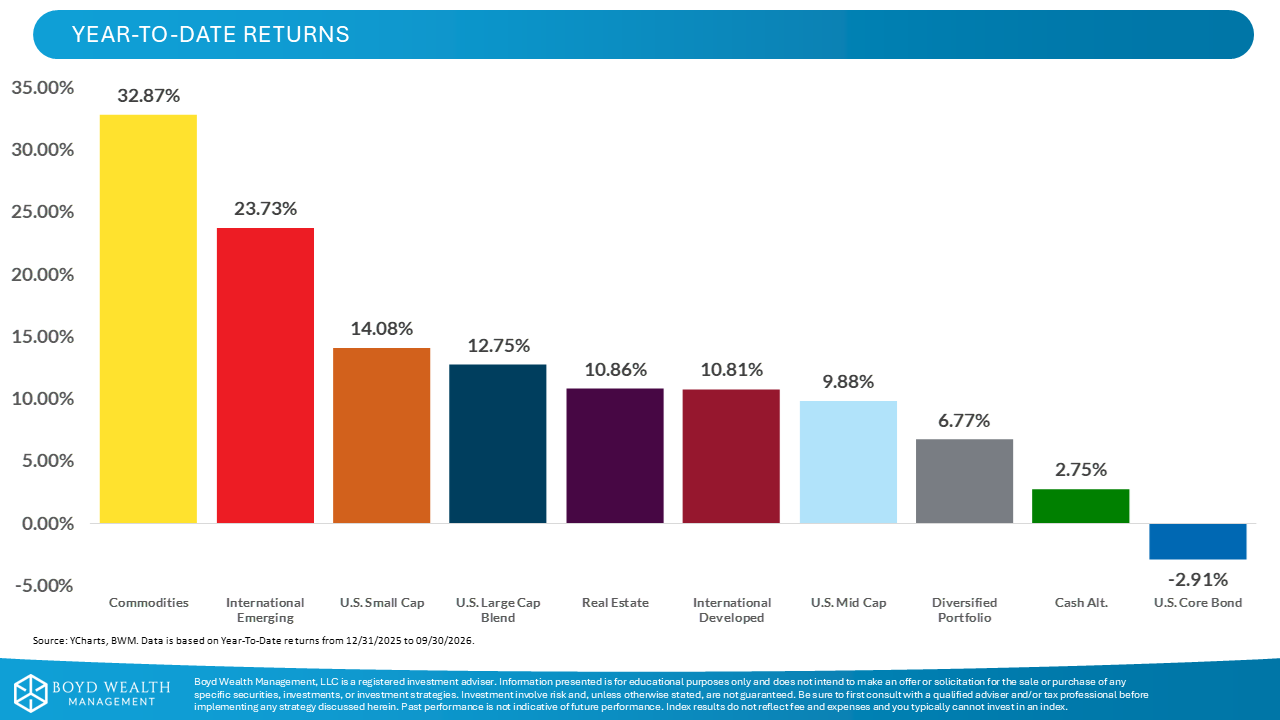
But so far in 2026, bonds have found themselves in an unusual position. While stocks, real estate, commodities, and other investments have generally enjoyed strong returns, bonds have struggled.
It's a useful reminder that different investments behave differently, often for good reasons.
So why are bonds down when so many other investments are up? Why can rising interest rates actually be good news for bond investors over time? And perhaps most importantly, why do we continue to own bonds in a diversified portfolio?
The answers tell us quite a bit about how successful investing works.
Why Are Bonds Struggling?
The broad U.S. bond market was down 2.91% through September, even as many other asset classes posted double-digit gains. The primary reason is rising longer-term interest rates.
The Federal Reserve influences short-term interest rates, but longer-term rates are largely determined by investors in the bond market. Those investors weigh factors like persistent inflation, our country's substantial fiscal deficits, and geopolitical uncertainty, including the war in Iran and the potential impact of higher energy prices on consumers.
When investors demand higher yields to compensate for these risks, interest rates rise. And that's where things get interesting for bondholders.
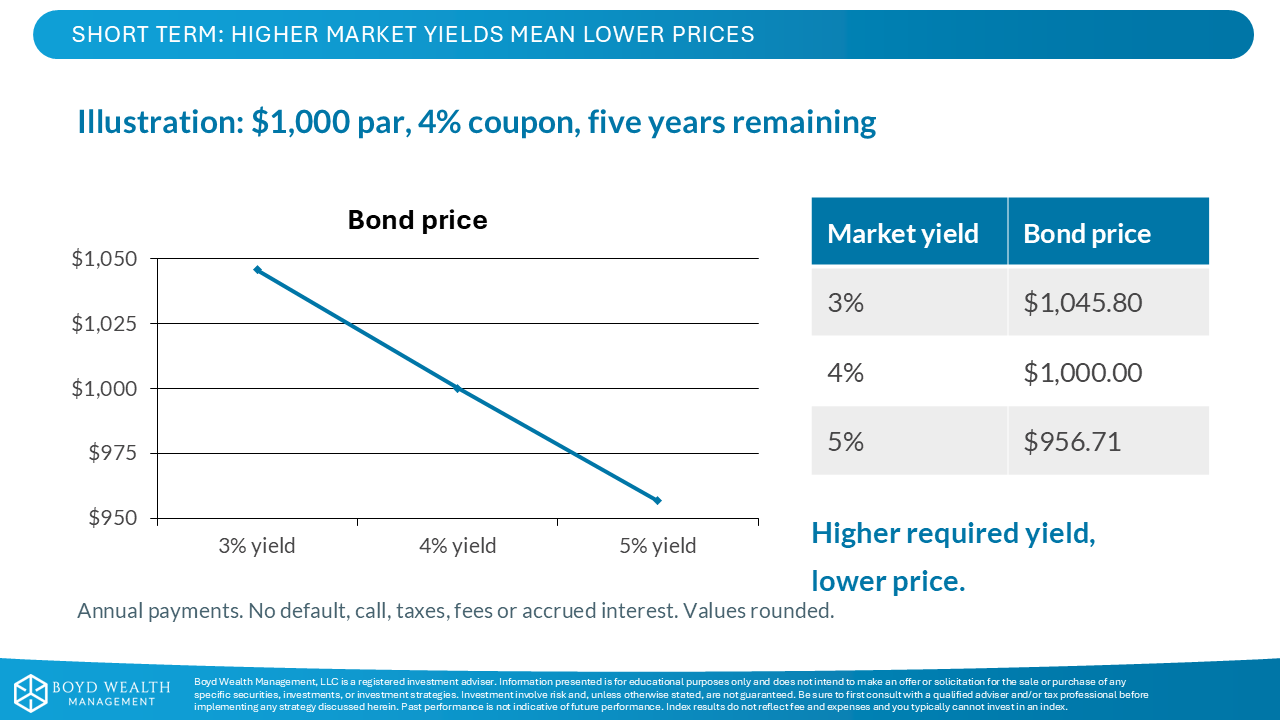
Bond prices and interest rates move in opposite directions.
Imagine you own a bond paying 4% interest. Now suppose a similar new bond is issued paying 5%. Why would someone pay full price for your 4% bond when they could purchase a new one paying 5%?
They wouldn't. To attract a buyer, the price of your bond would need to decline enough to make its return competitive with the newer bond.
That's why rising interest rates can temporarily hurt bond prices, even though the bonds themselves may continue making their scheduled interest payments. Assuming the issuer doesn't default, an individual bond will return to its full face value at maturity. So while its market price may fluctuate along the way, an investor who holds it to maturity doesn’t have to sell at a discounted price.
The Other Side of Higher Interest Rates
Higher rates aren’t all bad.
While higher rates can hurt existing bond prices in the short run, they can actually benefit bond investors over time.
As existing bonds mature, the proceeds can be reinvested in new bonds offering higher yields. That means more income flowing into the portfolio, income that can help offset earlier price declines over time.
Think about where we've been. Following the financial crisis in 2008, and again during the COVID pandemic, interest rates fell to extraordinarily low levels. For years, investors earned very little income from high-quality bonds.
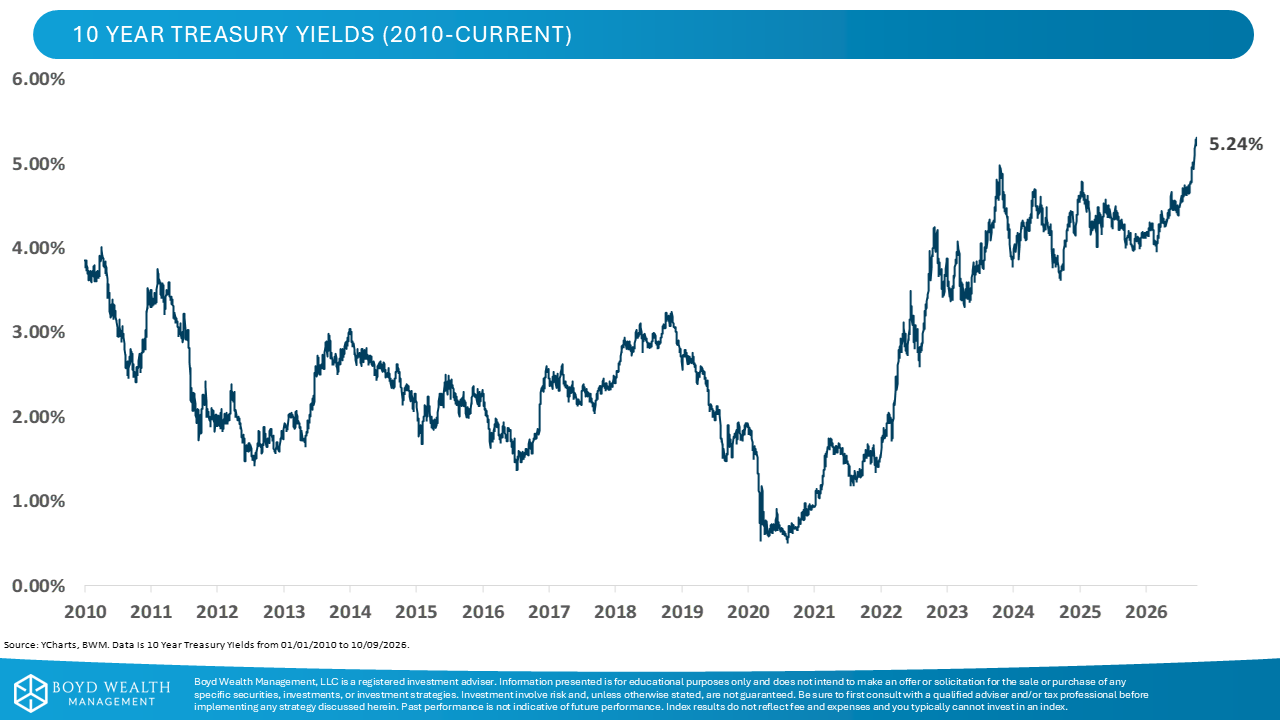
That environment began changing in 2021 as inflation picked up and interest rates started climbing.
The transition hasn't always been comfortable for bond investors, but the resulting higher yields mean that bonds today offer considerably more income potential than they did when interest rates were near zero.
Higher rates aren't entirely good or bad. They simply affect investors differently depending on their time horizon.
Why Own Bonds in the First Place?
This brings us to the bigger question.
If bonds can lose value when interest rates rise, why own them?
Because bonds serve a different purpose than stocks, and that's precisely why we include them in diversified portfolios.
Stocks generally provide the long-term growth engine. Bonds provide income and have historically helped soften the impact of difficult stock markets.
In fact, looking back over nearly a century, in calendar years when U.S. stocks declined, intermediate-term government bonds produced an average positive return of approximately 4.94%, while stocks declined an average of 13.43%.
That's a pretty compelling argument for owning something that isn't always exciting.
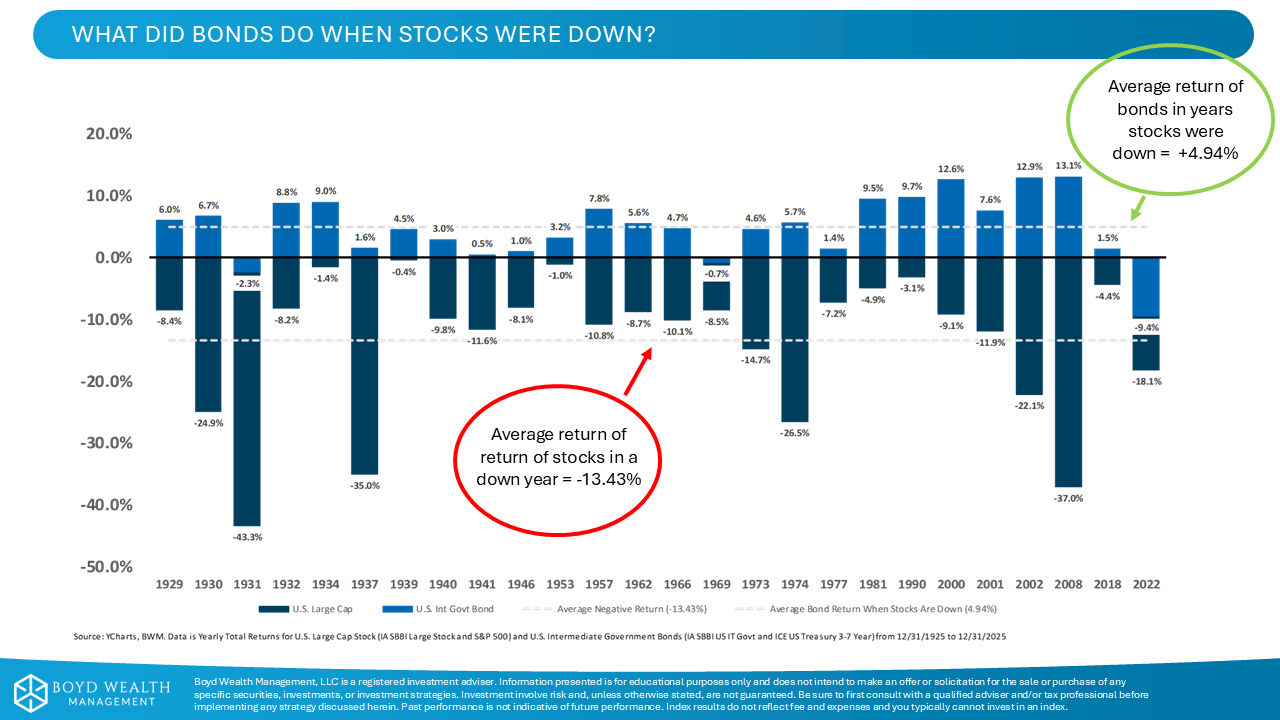
Of course, bonds don't always provide that protection.
In 2022, for example, stocks and bonds both experienced significant declines as inflation surged and interest rates rose rapidly.
However, in years like 2000 and 2008, with stocks down sharply, bonds provided a strong positive return.
Diversification doesn't guarantee that something in your portfolio will always be going up. It simply reduces your dependence on any one investment or economic outcome.
The Bigger Picture
No asset class performs well every year. That's not a flaw in diversification. It's part of how diversification works.
We don't know which investments will lead next year, and we don't pretend to.
Instead, we build portfolios with different investments serving different purposes. Some will inevitably outperform while others lag. Over time, those relationships will change, sometimes dramatically.
The success of a diversified portfolio isn't measured by whether every investment performs well in a given year. It's measured as a body of work, delivered over decades, that helps you accomplish the things that matter most to you.
Happy planning,
Brian