


Yesterday, markets rallied after the midterm results. Today the market has given all of it back. Here’s what happened over the last two days, why the moves were so different, and what it may mean for investment portfolios.
Stocks: Wednesday's Rally
As you may know, stocks had a very strong day yesterday. The Dow closed up 1,569 points (3%) at 53,356, the S&P 500 rose 1.6% to 7,689 and the Nasdaq added 1.4%. It was the Dow’s best day after a midterm election since 1982.
We believe three things drove the rally:
- The election results were clear, and the president said he would accept them, so the worry about a drawn-out challenge went away.
- Many investors expect a divided government to limit big policy swings.
- Oil prices fell sharply. Investors expect a Democratic Congress to increase pressure on the Trump administration to negotiate a settlement with Iran. That led to a drop of nearly 9% in Brent crude. Cheaper oil means less inflation pressure, which helped the sectors that benefit from lower gas prices and borrowing costs. Consumer discretionary stocks gained 4.3%, financials 3.5% and real estate 3.2%, while energy fell 4.8%.
The good news is yesterday's rally was broad, but not every part of the market joined in. Companies that rent out AI computing power, like CoreWeave and Nebius, fell more than 7% on worries about new limits on data center construction. That turned out to be a preview of what would come today.
Stocks: Today's Reversal
At market close, the Dow was down 3.44%, the S&P 500 was down 4.36% and the Nasdaq fell 5.52%. The Nasdaq is now in a correction, meaning it is more than 10% below its record high on October 6. The semiconductor index dropped 11%. The VIX, Wall Street’s “fear gauge,” has jumped to about 23, which is highest its been since April.
We believe the biggest reason was data centers. Democrats flipped the governor’s offices in Texas, Ohio and Georgia, and all three winners campaigned on pausing or reining in AI data centers. The fact that Texas flipped is a big deal. Wells Fargo estimates 27% of planned data center capacity is in the state. If data center construction slows, demand for chips and equipment slows too, and this is why you're seeing acute losses in the Technology sector.
Three other things likely added to the selling.
- Qualcomm said higher memory chip costs are hurting sales, and its stock dropped 11.5%.
- Oil rebounded 4.97% on reports of tankers on fire in the Strait of Hormuz.
- Weekly jobless claims fell back to the lowest level since 1969. Strong hiring data keeps a Fed rate hike on the table.
The top heaviness of the S&P 500 and other indices is a risk that continues to grow. Roughly two out of every five S&P 500 stocks were higher as of this writing1. What this indicates is investors are moving money out of tech and into other areas, not leaving stocks entirely.
A handful of AI companies make up a big share of the major indexes. In real numbers, the S&P 500 has lost more than $2 trillion in value, with Nvidia alone down more than $400 billion.
Bonds
Treasury yields fell on both days. The 10-year yield was 4.94% on Tuesday, fell to about 4.88% Wednesday and slipped to about 4.84% Thursday, with the 2-year yield down to about 4.53%. When yields fall, bond prices rise. This has helped diversified investors get the ballasting effect we expect out of fixed income. We wrote about this just two weeks ago.
Although the direction of rates was the same both days, the reasons were different. On Wednesday, investors expected less government borrowing and lower inflation from cheaper oil. Today, it appears traders bought Treasuries as a flight to safety. Short-term yields have fallen more than long-term yields so far today, which is a sign that investors are scaling back their bets on future Fed rate hikes.
What likely matters the most in this space is still the Fed. The Fed raised rates in September to a range of 3.75% to 4%, and markets still price about a 78% chance of another hike at the December meeting. It's worth noting that pressure is showing up in riskier AI-related corporate debt. As an example, some CoreWeave bonds traded as low as 79.5 cents on the dollar, with yields above 15%. A bond that cheap means investors have significant doubts about getting their money back at maturity.
What to Watch
The October jobs report comes out Friday, with economists expecting about 65,000 new jobs and unemployment of 4.2%. Then comes the inflation report on November 10 and the Fed meeting on December 8–9. The December 11 government funding deadline is also coming up. Hot jobs or inflation numbers could push yields back up at a time when stocks are already shaky.
How Our Models Approach This
This week shows why we don’t trade on headlines. A one-day rally followed by a one-day selloff doesn’t make a trend.
Our Dynamic models adjust equity exposure based on measurable data, including market trends and economic conditions. And our asset class rotation moves toward the parts of the market showing the strongest leadership and risk metrics.
If the shift we saw this week from tech/near tech toward sectors like consumer and health care stocks continues, the models are designed to respond once their signals confirm it, not after a single day.
The Bottom Line
In two days, the market went from celebrating the election to questioning the AI trade that has driven much of its gains. Neither day should change anyone’s long-term plan. The AI trade has repeatedly shown itself to be highly volatile over the lasty two years, so today shouldn't be a surprise to anyone. We should probably expect more of the same in 2027.
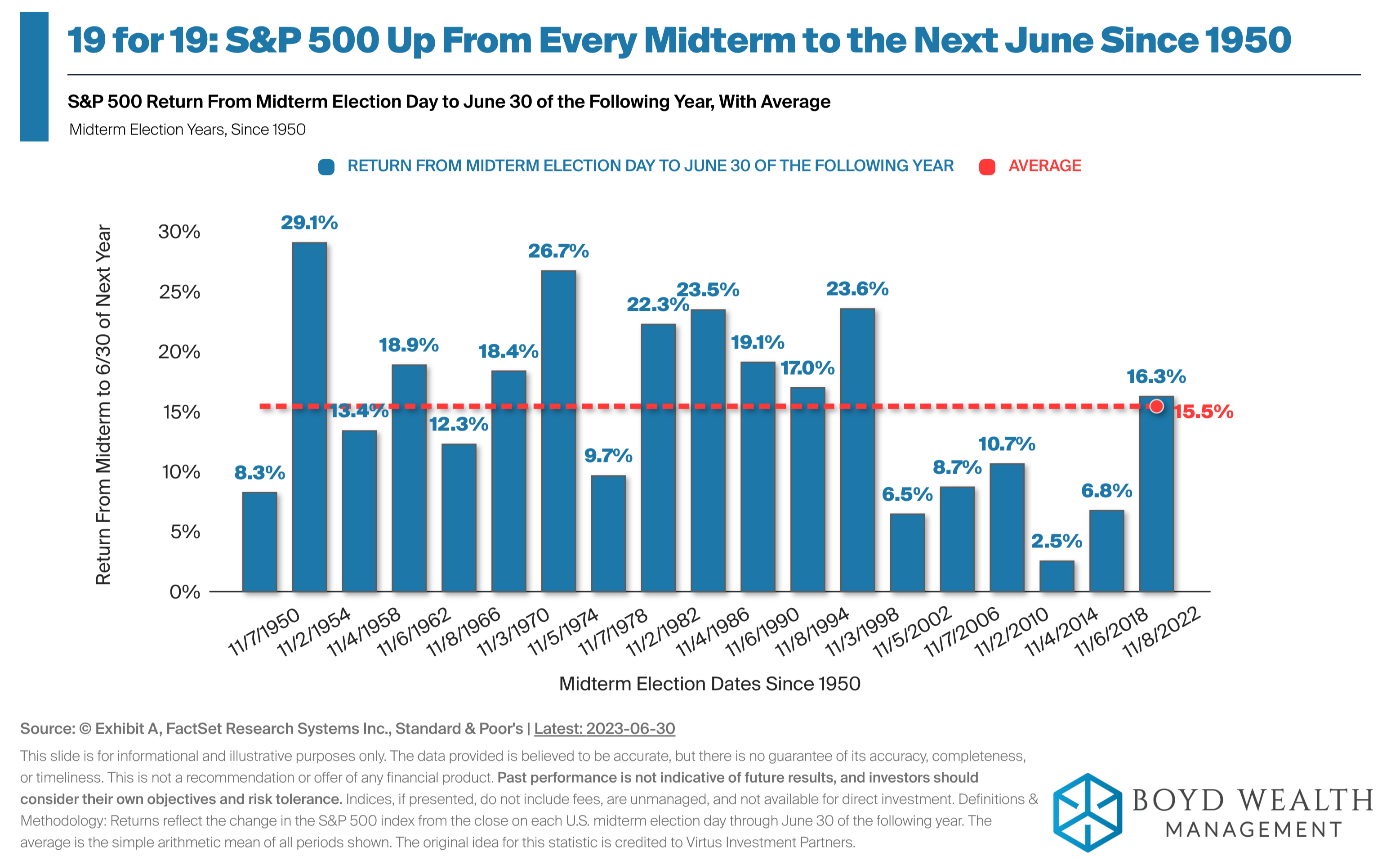
History has shown that the performance of the S&P 500 has been strong in the months following the last 19 midterm elections. The market cares more about corporate profits, interest rates, and economic growth, and less about who is in office. As always, past performance is no indication of future results.
Happy planning,
Brian
Sources:
1. Helios Quantitative Research